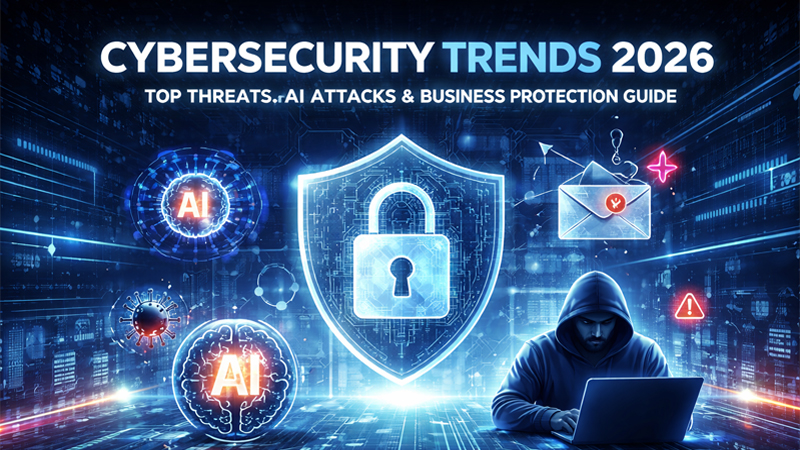
Cyber threats are evolving faster than ever, and in 2026, businesses face advanced attacks powered by artificial intelligence and automation. Every business, regardless of size, needs strong cybersecurity and data protection strategies.
Ignoring these cybersecurity trends can destroy your reputation overnight. In this guide, you will learn about the most dangerous cyber threats for businesses today. We will show you practical ways to protect your valuable data and systems.
What Are Cybersecurity Trends in 2026?
Cybersecurity trends in 2026 refer to the latest threats, technologies, and strategies businesses must adopt to protect their data, systems, and networks from evolving cyberattacks.
Top Cybersecurity Trends in 2026:
- AI-powered cyberattacks
- Ransomware evolution
- Identity-based attacks
- Cloud security risks
- Supply chain vulnerabilities
- IoT security threats
Here are the most important cybersecurity trends businesses must prepare for in 2026:
Why Cybersecurity Trends 2026 Demand Your Immediate Attention
The digital threat landscape has transformed dramatically since last year. Your business operates in an environment where attacks happen every 39 seconds. Cybercriminals now target companies of all sizes with sophisticated tools.
The World Economic Forum reports that cyber incidents rank among the top business risks. Geopolitical tensions have increased state-sponsored attacks targeting critical infrastructure. Waiting to strengthen your security puts your customer data at severe risk.
Key statistics you need to know:
- Cybercrime damages will cost businesses $10.5 trillion annually by 2025.
- 60% of small businesses close within six months of major breaches.
- Attacks using AI increased by 300% in 2025.
Top Cybersecurity Threats Every Business Must Understand in 2026
Modern cyber threats for businesses evolve constantly, requiring your continuous attention. The following threats represent the most pressing dangers your organization faces today.
AI-Powered Attacks Are Becoming More Sophisticated
Artificial intelligence has revolutionized how criminals launch attacks against your systems. Hackers now use AI tools to create compelling phishing emails instantly.
What AI enables attackers to do:
- Generate perfect phishing emails that bypass spam filters
- Create deepfake videos impersonating your executives
- Clone voices for phone scams (vishing or “voice phishing attacks)
- Scan networks 24/7 for vulnerabilities automatically
- Adapt attack methods in real-time based on defenses
Your traditional security tools often cannot detect these AI-generated threats effectively. This makes data protection more challenging than in previous years.
Ransomware Threats Have Evolved Beyond Simple File Encryption
Ransomware attacks have become more dangerous in 2026. Criminals no longer just lock your files and demand payment.
Modern ransomware tactics include:
- Double extortion: Stealing data before encrypting your systems
- Triple extortion: Threatening customers and partners directly
- RaaS platforms: Making attacks accessible to non-technical criminals
- Supply chain targeting: Compromising vendors to reach multiple victims
| Tactic | Impact on Your Business |
| Single Extortion | Loss of access to critical files |
| Double Extortion | Public exposure of sensitive data |
| Triple Extortion | Customer trust destruction and legal liability |
| RaaS Platforms | Massive increase in attack frequency |
Identity-Based Attacks Target Your User Credentials
Your employees’ passwords have become primary targets of attack. Criminals steal millions of credentials from data breaches.
How credential attacks work:
- Stolen passwords tested against your business systems
- Session hijacking steals active login sessions
- Information-stealing malware collects saved passwords
- Traditional MFA methods face new bypass techniques
The Verizon Data Breach Report confirms that credential theft causes 80% of breaches. Your users often reuse passwords across multiple accounts.
Cloud Configuration Mistakes Create Security Vulnerabilities
Your business likely uses cloud storage for daily operations. Cloud misconfigurations represent the most common security problems today.
Common cloud security mistakes:
- Leaving storage buckets publicly accessible
- Using weak or default authentication settings
- Failing to encrypt sensitive data properly
- Not monitoring access logs regularly
- Misconfigured network security groups
Most breaches result from human configuration errors rather than sophisticated hacks. Data protection requires understanding how your cloud services work.
Supply Chain Compromises Affect Multiple Connected Businesses
Attackers are increasingly targeting your vendors rather than attacking you directly. When your vendor is compromised, criminals gain access to your systems as well.
Why supply chain attacks are effective:
- Small businesses have weaker security than large enterprises
- Trust relationships provide easy network access
- One compromise affects dozens of connected organizations
- Software updates can inject malicious code silently
Edge Devices and IoT Expand Your Attack Surface
Internet of Things (IoT) devices create new entry points. Smart cameras, printers, and sensors often have weak security.
IoT security risks include:
- Users never change default passwords
- No security updates from manufacturers
- Difficult to monitor and manage remotely
- Used as entry points to corporate networks
- Nation-state actors targeting critical infrastructure
How Integrated IT Solutions Keeps Your Business Secure
At Integrated IT Solutions, we don’t just advise; we actively implement, monitor, and maintain security systems for businesses like yours. Based in Clarkston, WA, our team works hands-on with clients to close the gaps that cybercriminals exploit. Here’s how we work with you:
Step 1: Security Assessment
We begin with a thorough evaluation of your current systems, identifying vulnerabilities across your network, cloud environment, endpoints, and vendor connections. No guesswork, just a clear picture of your risk exposure.
Step 2: Tailored Protection Strategy
Every business is different. We design a layered security strategy that fits your size, industry, and budget, from MFA setup and patch management to AI-powered threat detection and server hardening.
Step 3: Implementation & Integration
Our developers and system administrators configure and deploy security tools directly. This includes server administration, custom AI bots for automated threat detection, and secure software and application development with built-in protection from the ground up.
Step 4: Continuous Monitoring & Support
Security is not a one-time fix. Our technical support team and virtual assistants provide 24/7 monitoring, rapid incident response, and regular reporting so threats are caught before they become crises.
Step 5: Vendor & Integration Security
We audit your third-party tools and custom integrations to ensure every connection to your business is secure, significantly reducing supply chain and third-party risk.
Ready to see how we work? Call us at +1 (509) 824-6322 or email us at info@integrated-itsolutions.com for a no-obligation security consultation.
Essential Data Protection Strategies Your Business Needs Now
Protecting your business requires implementing multiple layers of security. The following strategies defend against modern cyber threats for businesses effectively.
Comprehensive risk assessments identify where your business faces the most significant risks. You need to understand your vulnerabilities before selecting security tools.
Core Security Measures to Implement Immediately
Authentication and access control:
- Enable multi-factor authentication (MFA) on all accounts
- Use phishing-resistant authentication like hardware tokens
- Implement passwordless authentication where possible
- Deploy biometric verification for sensitive systems
- Require unique passwords for every account
System protection and updates:
- Enable automated patch management across all devices
- Prioritize critical security updates first
- Test patches before widespread deployment when possible
- Update mobile devices and remote systems regularly
- Replace unsupported software immediately
Employee training and awareness:
- Conduct monthly security awareness training sessions
- Run simulated phishing exercises quarterly
- Cover current security risks and threat awareness in training
- Make security part of company culture
- Reward employees who report suspicious activity
Data encryption and backup:
- Encrypt data at rest and in transit
- Use industry-standard encryption protocols
- Implement full-disk encryption on all devices
- Follow the 3-2-1 backup rule: three copies, two media, one offsite
- Test backup restoration procedures monthly
Monitoring and incident response:
- Deploy continuous monitoring and threat detection
- Set up automated alerts for suspicious activities
- Develop detailed incident response plans
- Conduct response drills quarterly
- Maintain relationships with forensic experts
Advanced Protection Strategies
Zero Trust Architecture implementation:
- Verify every access request explicitly
- Grant minimum necessary permissions only
- Assume breach has already occurred
- Segment networks to contain threats
- Monitor all network activity continuously
Vendor and third-party management:
- Evaluate the security practices of all vendors
- Require vendors to demonstrate data protection capabilities
- Include security requirements in contracts
- Monitor vendor security posture continuously
- Terminate access when partnerships end
AI-powered security tools:
- Deploy AI-driven endpoint detection and response (EDR) solutions
- Use machine learning threat detection models trained on your own environment
- Implement AI-generated phishing and anomaly detection for email security
- Test LLM-based security copilots for faster incident investigation
- Update security tools and detection models automatically as new threats appear
Why Small Businesses Cannot Ignore These Security Threats
Small and medium businesses face disproportionate targeting from cybercriminals. Attackers view smaller organizations as easier targets because they have fewer resources.
Critical facts about small business security:
- 43% of cyberattacks target small businesses
- Regulatory fines add thousands more in penalties
- Customer trust takes years to rebuild after breaches
Your customers expect you to protect their information correctly. Regulatory requirements increasingly mandate specific data protection measures for all businesses.
How Professional IT Services Strengthen Your Business Cybersecurity
Professional IT providers bring specialized expertise that most businesses cannot maintain internally. Your business benefits from their experience protecting hundreds of organizations.
Integrated IT Solutions offers comprehensive services tailored to your needs. Our team helps implement data protection strategies that fit your budget.
Our security services include:
- Technical support for 24/7 security monitoring
- Server administration with proper configuration
- Custom AI bots for automated threat detection
- Software development with built-in security
- Website development following security best practices
- Mobile application development with secure authentication
- Customized integrations connecting security tools
- Rapid incident response and forensic analysis
Professional services provide monitoring that internal teams cannot sustain. We offer expert response to security incidents. Managed security services cost less than hiring full-time specialists.
Book your security assessment today to identify current vulnerabilities. Our team creates tailored protection strategies. We provide virtual assistant services to efficiently handle routine security tasks.
Frequently Asked Questions
What are the most critical cybersecurity trends 2026 for small businesses?
AI-powered attacks, ransomware evolution, and identity-based threats top the list. Small businesses face increased targeting due to limited resources. Data protection through layered security controls is essential for survival.
How much should businesses invest in cyber threat protection?
Security budgets typically range from 5% to 10% of total IT spending. Investment depends on your industry and data sensitivity. Prevention costs far less than breach recovery expenses.
Can small businesses afford comprehensive data protection measures?
Yes, through managed security services and cloud-based tools. Integrated IT Solutions works directly with small businesses to build layered security that fits tight budgets. From server hardening and 24/7 technical support, we bring enterprise-level protection without the enterprise price tag. Our scalable managed services grow with your business, so you only pay for what you need.
What immediate steps should businesses take against cyber threats?
Enable multi-factor authentication and update all software immediately. Train employees and implement regular backups. Professional security assessments identify your most critical vulnerabilities.
Conclusion
Cybersecurity trends for 2026 present serious challenges that require proactive action. Cyber threats to businesses continue to evolve, including AI-powered attacks. Strong data protection strategies protect your reputation and financial stability.
Professional IT services provide expertise that internal teams cannot match. Contact Integrated IT Solutions today to strengthen your security.